Healing Complex PTSD from Childhood Trauma: Moving From Patterned to Purposeful
The Power of Deciding to Change
So much of our life, our stories, and our journeys come down to the decisions we make as individuals. The decision to go down a different path. The decision to choose what we want our lives to be. No matter where we come from, through the trauma, through the abuse, through the loss, we get to decide.
That decision can be incredibly difficult and harrowing. It asks you to become a version of yourself you did not even know you were capable of. I have talked about that in my own journey many times, and so have many of the guests who have joined me on the show over the years.
But what do you do when you feel that deeper calling? When something inside of you demands more, not only for yourself, but for the mark you want to leave on this thing we call life?
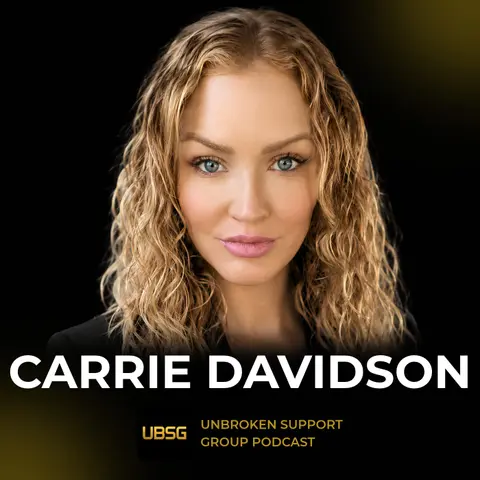
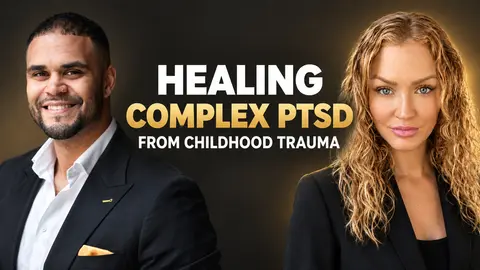
That is exactly what I got into with my friend Carrie Davidson on this episode of the podcast. Carrie is a registered nurse, a coach for people who come from complex trauma backgrounds, and someone who has walked through some of the darkest places a human being can walk through. This conversation is about healing from complex trauma, and about what it really takes to move from patterned to purposeful.
Understanding the Loop of Being Stuck
I asked Carrie why people should spend their time with us, and her answer went straight to the heart of it. A lot of people who come from a background marked by trauma, especially childhood trauma, get stuck in patterns that keep them from living a life they can claim as their own.
“I always say I've had nine lives, and I have a pretty unique perspective. I am a registered nurse, and I've also had my own journey of trauma as well. And I have been to some pretty dark places and really come out the other side.”
I know that loop well. When I look back at my entire twenties, all I can say is: I was stuck. My back was against the wall. Nothing was changing, nothing was shifting, and that feels really scary. But getting out of it requires you to make a shift and become who you actually are.
So I asked Carrie what stuck looked like in her own life.
“I have the awareness of what I need to be doing to change my life, but I'm still making the same decision even though I know better.”
For Carrie, especially in her twenties, that showed up as substance abuse. She knew the consequences of numbing her problems with alcohol or drugs, and she did it anyway. She would start new habits, they would not last, and she would revert to her old ways.
Why the unhealthy feels safe
What she eventually realized is one of the most important ideas in childhood trauma recovery. The patterns we repeat are not random. They are familiar, and familiar feels safe.
“What I came to really realize was that I was subconsciously addicted to these unhealthy behaviors that weren't serving me, but it was my safety zone.”
“Toxicity in relationships was familiar to me. And so that was what I kept going back to, was what felt safe and familiar, even though I knew it wasn't serving me anymore.”
If you have ever looked at your life and asked why you keep choosing the same thing that hurts you, sit with that. It may not be that you are weak. It may be that your system is choosing what it knows.
Moving Beyond Labels and Diagnoses
Even sixteen years into my own journey, I still catch myself in moments where I have to stop and ask, "Dude, what are you doing? Let's go."
One tool I have played with over the last three or four years, and a big part of what I used in coaching before I pivoted out of that world, is simple: What would future me think right now? I put on the hat of being 88 years old on my deathbed and ask, whose life did you live? That question became a powerful anchor for me.
But so many people get trapped in these moments, and then the doctors and therapists label us, and we end up in a constant cycle of asking what is wrong with us. For me, when I finally understood what was going on, there was a lot of freedom in that. So I asked Carrie what it was like for her to reach that level of understanding.
A diagnosis for the behavior, not the root
Carrie grew up with an alcoholic parent in a home where things were very unpredictable. She started acting out for attention because her needs were not being met. By 12 years old, she was already on medication.
“I was getting a diagnosis that fit my behavior, but wasn't actually getting to the root of what was going on for me, which was that I was in a very unstable environment as a child.”
The labels kept coming. ADHD in middle school. Depression and anxiety in high school. PTSD in her twenties. Each one felt like it fit, and she tried to identify with them. None of them got to the root.
That changed after a major trauma about 10 years ago, when she started learning about complex PTSD. A few years ago she read a book on the subject and said her reaction was, "Holy s***, this book is literally describing my life." It described the inner critic, the outer critic, and the way she saw the world. For the first time, it all made sense.
“It really opened my eyes to how much trauma really is the root of so many of these other mental health issues.”
Carrie pointed out that complex PTSD is not in the diagnostic manual. That matches what the U.S. Department of Veterans Affairs National Center for PTSD reports: complex PTSD is a diagnosis in the International Classification of Diseases, 11th Revision (ICD-11), but it is not a diagnosis in the DSM-5.
She also made a point I think every helping professional should hear. People rarely go back and ask what happened in childhood that led someone to pick up that first drink or that first line.
“People are trying to escape and find themselves at the end of the day.”
As a nurse, Carrie sees both sides. A diagnosis has real benefits. It helps clinicians know what medication to give, for example. But in her words, "I just think there's a lot more gray area when it comes to treating mental health and understanding trauma."
The Reality of the ACE Score
When I was about twenty-nine, I found an old YouTube video of Dr. Vincent Felitti talking about adverse childhood experiences. Dr. Felitti was Chief of Preventive Medicine at Kaiser Permanente in San Diego, and the CDC's 1998 announcement of the study linked traumatic childhood experiences to adult health problems. The study was carried out at Kaiser Permanente in collaboration with Dr. Robert Anda at the CDC, with the cooperation of 17,421 adult health plan members, according to a paper by Dr. Felitti published in The Permanente Journal.
I am a grown man, sitting there watching this video, and for the first time in my life I thought, "That's why I'm insane."
I used to have moments where I would look at my own behavior from the outside and think, this is what crazy people do. Then I would look in the mirror and realize I was the crazy person. Drinking and driving. Hooking up with strangers. Putting myself in precarious financial positions. Partying way too hard. I was the guy at the party with a fifth of rum or whiskey in his back pocket. I would drink the whole thing in a night and wake up on the stairs because I could not make it to bed.
Then you trace it back to the origins. I also come from a home of alcoholics. Most of my family members are alcoholics, and a lot of them are in recovery now, which is amazing. I remember the first time I had a beer at eight years old, and my grandma thought it was funny.
As I watched that video, the questions came one after another. Did your parents divorce? Was anyone in the household arrested? Was there sexual abuse in the home? Yes. Yes. Yes. I answered yes to all 10.
After tens of thousands of dollars in therapy, all the medications that never worked, and church and religious approaches that did not serve me, I finally had something that explained the crazy. So I asked Carrie what it was like for her to have that same kind of self-discovery.
Facing the Inner Critic and Breaking the Pattern
Carrie felt different from the people in her family for most of her life. She was more emotional than her sister. Her mom would ask what was wrong with her and why she reacted so strongly. In high school, she found herself in relationships with people who treated her poorly, and she tried to find her self-worth inside those relationships. When they did whatever they were doing, she would react, and people would say she was crazy.
“So I literally was just labeled as crazy when it was really just me trying to get my needs met.”
When your identity is built around the inner critic
Reading about complex PTSD, the inner critic hit hardest.
“I realized that my identity was built around this inner critic.”
Her self-talk was brutal: "You're stupid. What's wrong with you? You're psycho." She said things to herself that she would never say to a friend. She had labeled herself as broken, and she decided that you cannot fix broken.
From broken to patterned
Then came one of her rock bottoms. She has had many. And with it came a reframe that I think is one of the most powerful ideas in breaking trauma patterns.
“I am not broken, but I'm patterned, and patterns can change.”
For a long time, Carrie believed people could not change. She sees that differently now. But even back then, she could believe that a pattern could change.
“So that allowed me to at least feel some hope that I wasn't just doomed for a life that didn't feel like mine.”
Healing the Somatic and Physiological Body
Sometimes you need something that supports the pattern, almost like a mirror. I tell my team and the clients we work with, whether on the entrepreneur side with Unbroken Business Support Group or through Think Unbroken, the same thing: Show me your calendar and I'll show you your life.
I am not trying to be preachy. I have just lived it. Show me someone whose calendar is full of empty spaces and who is not doing the work, and I will find the chaos that follows.
A lot of people are trapped in the past. That is the handcuffs. That is the back against the wall. They are staring at a locked door, and they forget that the door is not actually locked. You just have to turn the handle.
In my own life, when I let myself lean on the excuses, which are reasonable, by the way, I end up smoking, drinking, hooking up with strangers, and ruining businesses, friendships, and relationships. How many times are you going to ruin your own life? I have touched rock bottom more than once. The upside of the bottom is that there is nowhere to go but up.
The body keeps the alarm running
One of the hardest parts of this journey is the transition. Many trauma survivors become high functioning. They become overachievers. Their nervous system is so dysregulated that they are going a hundred miles an hour. Show me some of the most successful entrepreneurs in the world, and I can probably show you the trauma in their lives.
We have the logical side of healing. We have the data, and we understand it. But what do you do with the physiology? What do you do with the embodiment of it, the whole somatic experience? I have come to believe that mindset is not enough. The physical awakening is a requirement of healing.
Carrie agreed. It took her a long time to realize that the reason she was not seeing progress was that she had been so high functioning. In college, she partied and used substances and still got good grades. When she went back for nursing school, she tried to do the same thing. She could still get away with some of it, but she felt terrible about herself, because her values had evolved without her realizing it.
The Role of Dissociation in Survival
Carrie opened up about moments in her life that forced her to dissociate from her body, starting when she was six years old.
The first chapter of the book she just wrote opens with a huge thunderstorm. She was six, her sister was four, and their dad was so drunk he was passed out upstairs. They tried to wake him and could not.
“And it was a moment for me that I realized, well, I can leave my body and not experience this, that dissociation.”
It happened again when she was sexually assaulted at 14. She did not recognize it as an assault until she was sitting in a therapist's office 10 years later. At the time, she thought she was cool because she was with an older guy. She did not realize she had completely left her body to get through it.
About 10 years ago, while living in San Diego, Carrie was drugged by someone she knew, went into psychosis, and was kidnapped in Tijuana. She was there for three days.
“My brain literally created an entire identity that was not me to get through that.”
She even gave that identity a new name. It is an extreme example of dissociation, and for the last 10 years she has been actively working to heal from all of it.
You cannot think your way out
Here is the part that I believe so many high-functioning survivors need to hear.
“I thought that I could think my way out of it.”
She would get down on herself. Think harder. Think differently. Read more books. Her inner critic told her she was not strong enough or smart enough to get over it.
“The whole time my body had been setting off alarms, pits in my stomach, panic attacks, just random skin breakouts. My body was trying to give me so many signals that I just ignored.”
It was not until she entered recovery from drugs and alcohol that she had to learn to sit with the discomfort in her body and listen to what it was trying to tell her.
When safety feels unsafe
This showed up in her relationships. After a long pattern of unhealthy relationships, she is now in a healthy one, and at first, "a healthy relationship felt unsafe to me." Her body gave her the same uneasy feeling even though she was safe, and she had to retrain her body to understand what she was experiencing.
It showed up with food, too. Carrie's mom raised Carrie and her sister as a single mom and worked very hard to give them a good life. Because of that, they did not sit down for family dinners. Sometimes her mom got home at 5 p.m. and sometimes at 9 p.m. Dinner was unpredictable, so Carrie learned to ignore hunger. She did not start to work through that until her thirties.
“It's just little situations like that that honestly took me three decades to even understand what was happening.”
This is what somatic healing and overcoming dissociation often look like in real life. Not one big breakthrough, but learning, slowly, to feel what your body has been telling you all along.
Why Business and Growth Accelerate Healing
So much of healing is an unraveling. It is like you are wearing a cozy, warm trauma sweater, and one day you find a thread and pull on it. Thirty years later, you are still pulling.
This is my opinion, based on coaching thousands of trauma survivors and doing this show for a very long time. When you sign the dotted line for this journey, it is for the rest of your life. That does not mean you do not pivot or change. It means the next thing is always coming.
That is why I have encouraged people to think about becoming an entrepreneur, starting a business, or doing anything that requires them to grow as a human being. It is one of the fastest ways to unravel that sweater, because who you are today is not capable of your dreams. But the person you become will value the person you are today who decides to take the step.
Sometimes that step is therapy. Sometimes it is coaching, like the work Carrie does. Sometimes it is reading a book. And it is always sitting in the truth of what happened, which is the hardest part, because it is the place we do not want to go. It is the darkness, the pain, the loss, the suffering, and the abuse: mental, emotional, physical, spiritual, financial, and sexual. You have to walk through it.
Stop walking into the same door
Or you look at your life and see the same thing happening over and over. Think about the movie Groundhog Day with Bill Murray. He lives the same day again and again until he gets it right. I think life works like that. The universe keeps teaching you the same lesson until you are tired of learning it.
Whether it is your relationship, your job, or your own destructive behaviors, here is the analogy I have used with the people I coached and with myself: How many times are you going to get punched in the face before you stop walking into that door? You have two options. Get punched in the face, or walk through the other door. For me, it took 20 years of getting punched in the face. For some people, it takes two.
The hardest part is that now you are required to become you. The actual you, not whoever you created to survive.
Levels of survival
Having the power to dissociate was probably a gift in a moment like being kidnapped in Tijuana. There are levels to this. My best friend and I were locked in a closet at gunpoint during a bad drug deal when we were 12. That is a crazy level.
But your boss calling you in for a performance review should not make you dissociate. Going to the doctor to get blood drawn, which is a true story for me, should not make you dissociate. So we work on getting back into our bodies. Therapy, yoga, meditation, all of it. But I also believe you need something you are moving toward.
Creating something from nothing
When I asked Carrie what she was moving toward, she said it was creating something from nothing. She shared a favorite Kanye West lyric about the most beautiful thoughts sitting right beside the darkest ones, and that idea has always stayed with her.
When she could not get herself together, she asked herself what action she could take to feel something different. Art, writing, and journaling became outlets. In a rehab program after the events in Mexico, she started journaling about her experience and had an aha moment: she was going to do something with this one day, even if she did not know what.
“This didn't happen to me, it happened for me.”
That shift from victim to purpose gave her direction. She describes herself as "almost delusional" about having a mission: to help people who have been through hard times and trauma, and to walk alongside them as someone who has been there too.
Creating built her self-confidence. And finishing mattered as much as starting.
“Just starting a project and actually finishing it. Whereas before, I would start 15 projects and not finish any of them.”
The Requirement of Radical Honesty
While Carrie was talking, I wrote a note to myself: across the finish line. Between the ADHD, being an entrepreneur, and the trauma, I used to try all the things all the time. That does not work. Deciding on one thing and seeing it through, whatever the outcome, becomes a superpower. Dedication to the thing is what makes you you.
People tend to do one of two things. They quit, or they fake it.
Performative healing
In the journey of healing from complex trauma, you see a lot of people who are performatively healing. Social media probably does not help. There are people for whom it becomes performance art: I go to therapy, I go to yoga, I read the books. And yet their life is a mess. How do I know? Because that was me for a while.
From 26 to 30, it was hell every single day. Two steps forward, 25 steps back, again and again. Until one day I decided, this is who I am, and I am going to own it. All of it. The good, the bad, and the indifferent.
That is where radical accountability begins. There is a vicious requirement of honesty with yourself about your own identity if you want to create real change in your life. People often tell me I am the most honest person they know. I tell them it is because when I lie, I hate myself. That does not mean I never do it. When I do, I go back and apologize, because that is the journey.
Performing is survival. You learn to be someone else just to make it through the day. Mom is drunk, stepdad is drunk, nobody takes care of you, you do not know when you are eating, and you have to figure out how to get through. Then one day you realize that way of living does not serve you anymore, and the truth finally comes out. You look at every bucket of your life, mental, emotional, physical, spiritual, sexual, and financial, and you say: I own this. This is my reality.
The chameleon
Carrie related to all of it. When she started her coaching program, one assignment asked when she first remembered not being authentic. Her answer: 15 years old, dating a guy, shopping and wondering what he would want her to wear instead of what made her feel good. Today, she extends compassion to that 15-year-old girl.
She tried on many identities and spent time with many different kinds of people. She was a chameleon.
“I could blend into any environment, and from the outside it would look like I had been there all along or that is who I really was.”
It was not until she started her own business that she was forced to look at all the parts of herself she had been lying to herself about. She had always felt guilty about not being honest with other people, and she understood it as a survival mechanism. The real wake-up call went deeper.
“I'm not just trying to perform for other people, I'm lying to myself.”
“That's why I feel like s*** every day, is because my inner world doesn't match my outer world. I'm not in alignment with myself.”
As she put it, how can you find your purpose if you tell yourself one thing, do another, and tell someone else something completely different?
“And the brutal honesty aspect has been honestly the game changer for me. And it's helped my relationships, it's helped my business, it's helped everything.”
Shedding the False Identity
I asked Carrie what part of herself she had to let go of to become who she is now. For me, it was the guy who could figure it all out.
I was great at faking confidence. At 12, 15, 18, 22, 25, 27, and probably into my early thirties, my answer was always: I got it. I'll figure it out. I'm strong enough. I don't need anyone's help. I believe "I don't need people's help" is the biggest trap in the world.
That identity was a huge part of me because, as a kid, I had to be that guy. I took care of my brothers. I took care of the home. Sometimes I had to hustle to pay bills. It was the pressure of the world on a child, and I did not get to have a childhood. A lot of the people listening to this podcast know exactly what that feels like. When I finally started asking for help, everything changed.
The party girl who was really an introvert
For Carrie, it was the exterior. She was known as the fun party girl, the extrovert who could walk up to a group of strangers and start a conversation about anything. She believed that was who she was. She put a lot of her self-worth into her appearance. In college, it could take her three hours to get ready.
When she got honest with herself, the picture changed.
“I actually don't think I'm an extrovert. I recharge when I'm alone.”
She finds joy in reading and nerding out about things, the complete opposite of the party girl image. Some of the people who have known her for years have had to adjust to the change in her as she becomes true to herself. Shedding who she thought she was, and what she thought made her happy, was a pivotal moment.
Finding Alignment and Community
That moment is where everything changes. You admit you are not happy, and then you ask how long you are willing to stay that way. Change happens slowly. Nobody wakes up one day and everything is great. It is a process like anything else.
Today, Carrie still works two days a week as a bedside nurse at the hospital. Outside of that, she works with people who come from complex trauma backgrounds through one-on-one coaching and self-paced six-week online courses. She also runs a free online community with a monthly Zoom meeting for support.
“I really believe that healing can't happen in isolation. It has to happen in community. I've tried to heal in isolation, and it hasn't gotten me very far.”
If you know you are on this journey and you want support from someone who has done the thing you are trying to do, reach out to Carrie. At the very least, show up for her free monthly Zoom call. Your time is as important as money, and in the beginning, it may be the most important thing you have.
What it means to be unbroken
I closed the way I always do. What does it mean to be unbroken?
Carrie said the word alignment kept coming up for her. She thought about the Japanese practice of repairing broken ceramics with gold. That practice is called kintsugi, which Britannica describes as a traditional Japanese technique of repairing ceramics with lacquer and a metal powder, usually gold or silver.
“When I think about being unbroken, it's about recognizing that our lives can be in a million different pieces, but that it can still be put back together, and healing is possible no matter how bad things get, and to truly live in alignment with what makes us happy.”
“It can be hard to find out what that is, but with persistence and determination and self honesty, people can get there.”
This journey, for all of us, is about recognizing where we are, doing what is required to become the person we are capable of being, and then shining a light for others to follow.
Key Takeaways
•Familiar is not the same as safe. Many trauma patterns repeat because they feel known, not because they serve you.
•A label is not the root. Diagnoses can help, but healing from complex trauma means asking what happened, not only what is wrong.
•You are patterned, not broken. Patterns can change.
•You cannot think your way out. Somatic healing means learning to listen to the signals your body has been sending all along.
•Dissociation was survival. The work is learning to come back into your body when the danger has passed.
•Growth speeds up healing. Building something, and finishing it, forces you to become someone new.
•Radical honesty starts with yourself. When your inner world matches your outer world, you can find alignment.
•Let go of the identity you built to survive. For me, it was "I don't need help." For Carrie, it was the party girl.
•Do not heal alone. Community is part of the work.
Connect with Carrie Davidson
•Website: carriepdavidson.com
•Book: Addicted to Trauma, listed on Carrie's website
•Coaching, six-week online courses, and a free monthly community Zoom call
For the full episode and show notes, visit unbrokenbsgpodcast.com.
If this conversation gave you value, share it with someone who needs to hear that they are not broken. They are patterned, and patterns can change.
Take care of yourselves, take care of each other, and until next time, be unbroken.
Sources
•U.S. Department of Veterans Affairs, National Center for PTSD, Complex PTSD: History and Definitions: https://www.ptsd.va.gov/professional/treat/essentials/complex_ptsd.asp
•CDC Newsroom, Adult Health Problems Linked to Traumatic Childhood Experiences (1998): https://archive.cdc.gov/www_cdc_gov/media/pressrel/r980514.htm
•Felitti, V. J., The Relation Between Adverse Childhood Experiences and Adult Health, The Permanente Journal: https://pmc.ncbi.nlm.nih.gov/articles/PMC6220625/
•Britannica, Kintsugi: https://www.britannica.com/art/kintsugi-ceramics
•Carrie Davidson official website: https://carriepdavidson.com


Why Am I Like This? Breaking Toxic Relationship Patterns with Sabrina Zohar