From $1M in Debt and Food Stamps to Financial Freedom: Chris Miles on Rebuilding After Failure
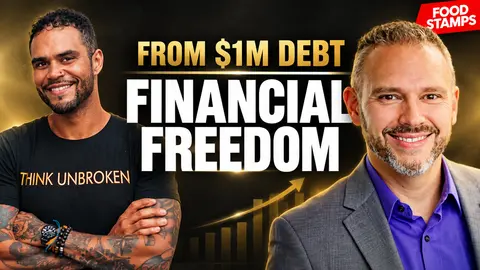
Entrepreneurship Is Peaks and Valleys
Chris opened with a truth every business owner eventually learns the hard way:
"Entrepreneurship is definitely not a straight up angle. It's not just all peaks. There's peaks and valleys. And the biggest determination of success is how do you get through those valleys."
If you are in a valley right now, in business or in life, this conversation is for you.
Escaping the Cookie-Cutter Life
You would not have picked Chris as a future entrepreneur. As a kid, he dealt with major social anxiety. He hid from cameras and, in his words, was "a nerdy kid basically."
What drove him was a refusal to live an ordinary life. He grew up between two extremes. His father followed the traditional path: go to school, get good grades, get a secure job, stay for 40 years. Even so, his dad was laid off a few times. His mother was a painter, trained by the same master painter who trained Bob Ross, and the family lived with constant scarcity. "Money doesn't grow on trees" was the soundtrack of his childhood.
His dad did teach him two things that stuck: be a man of your word, and look for the proof.
Chris planned to become a business consultant. With one class left before finishing his bachelor's degree, he decided to take a one-year break to get real-world experience first. The first opportunity that came up was becoming a financial advisor. He loved being his own boss so much that he never went back to finish the degree, despite a 3.9 GPA.
"I didn't want to live the cookie cutter stamp life of work nine to five, go to college, get good grades, get your job, die."
The Trap of Corporate Scarcity
I related to this deeply. At 20 years old, I landed a job with a Fortune 10 company making $150,000 to $200,000 a year. I had no high school diploma. I grew up in the hood with parents who were drug addicts. On paper, I had made it.
Then one day the guy in the cubicle next to me came back from lunch crying. He had been written up for taking too long in the bathroom. We were generating millions in revenue for that company, and they were focused on three minutes.
That night I told my best friend I was quitting to chase professional photography. His response: "You will never make that much money again in your life." Today I can make that money in a week.
Chris had his own version of that story. While building his financial advising practice on the side, which was 100% commission with no base pay, he worked a customer service phone job for about $11 an hour. Employees got six minutes total for bathroom breaks per day. Go over, and you got written up.
He worked from 8 a.m. to sometimes past 9 p.m. juggling both. Eventually he ran the numbers: the job paid him $13,000 a year for 30 hours a week, and he had about $18,000 of advising business potentially closing in the next month or so. He resigned.
The euphoria lasted about a week or two. Then reality set in. He had a newborn at home, his wife was no longer working, and every dollar depended on him.
"That pressure was crippling. And that scarcity, not knowing what scarcity was at the time... that scarcity was creeping in."
Clients who had felt good about working with him started backing away. The desperation was showing.
Four Dollars at 3 A.M.: The Breaking Point
Chris has a name for that desperation: commission breath.
"The more desperate, the more scarce you go into, the more business breath you have. And it actually can work against you. It actually can drive people away energetically. It's when you don't need the money, that's when people always want to do business with you."
A few months after quitting, on a cold November night, Chris hit bottom. Out of money and too proud to go back to his old job, he had an idea. People drop change in drive-thrus all the time. So he set his alarm for midnight.
It was 25 degrees outside. He hit every drive-thru within about a five-mile radius: sandwich shops, bank drive-thrus, and a Wendy's that was open until 2 a.m., where he ducked under the window so the staff wouldn't see him. He dug coins out of the tar until his nail peeled back from the skin.
He got home at 3 a.m., counted it out, and had four dollars.
"I made like a dollar an hour... I could have made more money working in that drive-thru window in an hour than I did in three hours trying to pick up change."
He took another job, this time doing outbound renewal and upsell calls for Ancestry.com. He was among the top upsellers by conversion, but because pay was based on a curve and he spent so much time actually helping people with their genealogy research, he landed around $11 an hour while faster dialers earned about $22. During that period his car was repossessed, and he borrowed a neighbor's 1980s Chevy with the roof caving in. He had nightmares about dialing, only to wake up to the 6 a.m. alarm for the real thing.
Family kept telling him to go back and finish his degree. What actually turned things around was a different opportunity that fit his gifts better. Once he had stable income and relaxed a bit, his advising business started to grow too.
Business Is a Skills Game
The parallels between entrepreneurs are almost uncanny. I had a car repossessed too: my dream car, a 2004 Cadillac CTS. I had paid off nearly all of it, with about two grand left. When my first business wasn't making money, it got repo'd. If I had just paid it off instead of buying drinks at the bar, I would probably still have it.
Before Think Unbroken took off about 10 years ago, there were times I borrowed money from my girlfriend who lived with me just to cover rent. Any entrepreneur who says it worked from the beginning is not telling you the whole story. The pain is your ticket of admission.
Here is what I have learned:
Business is a skills game. It is not an idea game. It is not a dream game. It is not an "I think I can help people" game. It is a literal skills game.
And the moment you stop needing the sale is the moment selling gets easier. I teach my sales team one tip: I don't care about their money. You're an adult. Make a decision. I learned that knocking doors selling Cutco knives at 18. The moment you force someone, they pull away.
Shifting from Scarcity to Abundance
During his years as a financial advisor, from 2002 to 2006, Chris became a student of personal development. He read Rich Dad Poor Dad, read Think and Grow Rich three times, and started with How to Win Friends and Influence People, a book he still recommends to his kids.
But he did not realize how much scarcity surrounded him in that office. You tend to attract people who are most like you.
"It wasn't until I got around a different group of people and they literally were bringing that intention out, saying, this, abundance versus scarcity. This is everything when it comes to money, business, and even just your life in general for happiness."
He even tried copying a leader in his company who made millions, shouting his vision statement out loud: "I'm making $250,000 a year." His own mind shot back that he was barely making a couple thousand a month. He had the words but not the energy or the belief to match. He had brought an $11.69-an-hour mindset into business, and his income reflected it.
Questioning the Traditional Financial Path
In 2005, things came to a head. A neighbor connected him to a role as a stock coach. They trained him to trade stocks and options and then teach others. He picked it up fast, and out of 60 coaches, he was the second highest rated. The only coach ahead of him took on roughly twice as many clients. The role paid well, so he relaxed, and his advising income rose too.
That November, his father asked Chris to look at his finances. His dad was the post-Depression-era saver who did everything "right": maxed his 401(k), stayed debt free, threw nothing away.
"I said, Dad, you're 61 years old. If you want to retire today, you have to die in six years."
His dad ended up working into his 70s. That shook Chris. If the poster child for the traditional path was still not free, something was wrong with the path.
About a month later, he called a friend he had trained as an advisor who had left for real estate investing. The friend asked two questions:
- How many of your clients are financially free, where they don't worry about money? Chris's answer: none. Even retirees worried about running out too soon.
- How many of the advisors in the office are financially free from their investments, not their commissions? Chris's answer: none, maybe one. And he later found out that one wasn't either.
"Well, there's your problem," his friend said.
That friend's circle taught him a different way of thinking. Faith, not fear, because they cannot exist at the same time. No limits. And a simple shift in language: instead of "I can't afford this," ask "How can I afford this? How can I make this work?"
Chris quit financial advising in March 2006. He kept stock coaching, became a mortgage broker, invested in real estate, and got creative. For example, his father added him as an authorized user on a credit card (and shredded the card) so Chris could borrow his credit history. His score jumped 23 points in one month.
By later that year, he needed about $3,500 a month to live on and had roughly $4,000 to $5,000 a month coming in from investments and business streams. He was referring his mortgage work to someone else and, at 28, could have retired.
"My mindset was the number one block."
Money Magnifies Who You Already Are
When I bought that Cadillac, I wasn't really in a position to afford it. I bought it believing it would pull me into becoming the person who could. So I asked Chris where his head was when he bought his first Mercedes.
His answer was refreshingly honest:
"Money is the magnifier of the soul. It only makes you more of who you already are. It amplifies the inside of your internal world to the external world."
Right after buying the car, he went back to his old advising office and offered to drive his former trainer to lunch, across the parking lot, a distance they could have walked, just to show off. He bought a show home worth over $600,000, finished the basement, and brought it to roughly three quarters of a million dollars in 2006: about 5,000 square feet, seven bedrooms.
"I didn't know how valuable I really was. I was using my things as a way to show, look how valuable I am."
Nobody listened to him more because of the car. The only person who commented was an 18-year-old who loved the rims. The house, his dream home, was lost in 2009.
The Million Dollar Debt and Food Stamps
In 2006, Chris had locked in a principle that changed how he made money: dollars follow value created.
"How do you add value in such a way that people realize that having you in their life is more valuable than the money that's just sitting in their bank account or in their pocket?"
He had once believed you made money by getting lucky, getting in at the right time, or screwing somebody over. When he realized money was formulaic and built on win-win value, making it became much easier.
Then 2007 arrived. Chris had joined partners in a business designed to help people get out of the rat race. A main partner asked him to cut off some of his other income streams and go all in. Then the real estate market shifted, and the company started going broke. So did Chris.
He felt like a fraud, teaching people how to escape the rat race while he was stuck back in it. With three small children and his wife relying fully on him, he felt he was failing at his most important job. By 2008, he was on food stamps. He eventually found himself more than a million dollars in debt.
Instead of quitting, he pivoted. People kept telling him they wanted his help but couldn't afford it. So he asked a better question: "If I could help you find the money, would you pay me?"
He started teaching business owners how to find money: pointing them to a CPA who could cut taxes they were likely overpaying, and teaching a debt payoff method he created for himself, the Cash Flow Index. He says it came out of the depths of his despair, and that some of his most helpful ideas came from that exact period.
The climb was not linear. There was hope, then a crash, then hope again. He lost the house in spring 2009. The family sold almost everything and hid the minivan in the garage so it wouldn't be repossessed.
In August 2009, during another argument, his wife demanded to know when they would actually get out of this mess. He told her he didn't know, but that they would. Then he reached a point of surrender:
"I don't care if this takes 20 years. I know that if I follow the right principles, if I do what's right, the rest is gonna follow."
By the end of September 2009, the first glimmer of hope appeared. By October and November, the company was pulling out of bankruptcy. Chris had been coaching chiropractic and dental coaches, and one chiropractic coach saved about $50,000 a year in taxes. He broke down in tears and referred all of his clients.
The company went from nearly bankrupt in 2009 to over $5 million in coaching sales alone in 2010.
The Three E's: Exercise, Education, and Enlightenment
What kept Chris going mentally during the worst of it? A few things.
Two books helped put his situation in perspective:
- Never Give Up by Donald Trump, which Chris said discusses failures far larger than his own.
- Three Feet from Gold by Greg Reid and Sharon Lechter, about people who were on the verge of quitting and kept pushing just long enough.
He also built a daily morning routine he calls the Three E's. Tony Robbins calls a similar practice the hour of power, and Hal Elrod teaches a morning ritual. The goal was simple: if he went to bed feeling like a loser, he would start the next day with a win.
- Exercise. He couldn't pray first thing because he would fall asleep, so he moved his body first. Running was free, no gym membership required.
- Enlightenment. Prayer, meditation, reading scripture, or journaling.
- Education. Books, audiobooks, and podcasts to feed his mind.
He also chose to believe that everything happens for a reason, acknowledging that some people would disagree. He asked himself whether his pain would be worth it if even one person benefited. His answer was yes. He calls what carried him through "fumes of faith."
At one point, he was eating free Chick-fil-A sandwich coupons that a franchise owner had dropped off at work, so his family could have the food from their assistance benefits.
"I didn't know the solution, but I knew if I just kept trying to deliver value, it kept just moving forward, eventually it would pay off."
My own comeback looked similar. After closing my business and moving to a new city around 2012 to 2013, I started ideating what would become Think Unbroken. I reached out for help, talked about what I was going through, and built a routine of journaling, exercising, and studying. I made learning my number one goal.
People give up so quickly. "I've been trying for three months." Three months is nothing. Talk to me in 30 years.
Becoming Antifragile
By the end of 2016, Chris had built enough passive income to get out of the rat race a second time.
"I tell people I was able to retire twice by the time I was 39, not because I'm smart, but because I screwed up the first time."
Today, through Money Ripples, he teaches people how to buy their time back and become what he calls "work optional": having enough passive income to work because you want to, not because you have to. He doesn't need to run the company. He does it because he doesn't feel fulfilled unless he is helping others and creating a ripple effect, which is where the name comes from.
When I asked what it means to be unbroken, Chris pointed to a book he had just finished, Antifragile by Nassim Nicholas Taleb. He explained that he used to think resilience was the opposite of fragile, but the book changed his view.
"It's not being stiff and rigid. Because just think of like a tree. If it's stiff and rigid, it breaks. But the trees that have experienced those high force winds, not only are they able to bend with the wind, but they have deep roots."
To him, being unbroken means having faith that if you follow true principles and do what is right, the right things will happen at the right time.
I agree completely. People have it backwards. They think they have to do it before they can believe it. The truth is you have to believe it before you do it. The believing comes before the creating.
Key Takeaways
If you are trying to figure out how to rebuild after financial failure, here is what Chris's story teaches:
- Expect the valleys. Success is determined by how you get through the low points, not by avoiding them.
- Watch for commission breath. Desperation repels people. Stabilizing your income can actually help your business grow.
- Build skills, not just dreams. Business is a skills game.
- Audit your environment. Scarcity is contagious. Get around people who think in possibilities.
- Change your questions. Replace "I can't afford this" with "How can I make this work?"
- Follow value. Dollars follow value created. Look for the win-win.
- Know what money magnifies. Things will not fix your self-worth. Money amplifies who you already are.
- Start each day with a win. Exercise, enlightenment, and education can rebuild your mind when everything else is falling apart.
- Be antifragile. Bend with the wind and grow deep roots.
Learn More About Chris Miles
Find Chris at moneyripples.com, follow @MoneyRipples on social media, or listen to the Money Ripples podcast, now in its thirteenth season.
If someone in your life needs the reminder that this too shall pass, maybe it's you, share this post with them.
Take care of yourselves, take care of each other, and until next time, be unbroken.


Why Am I Like This? Breaking Toxic Relationship Patterns with Sabrina Zohar